Overview
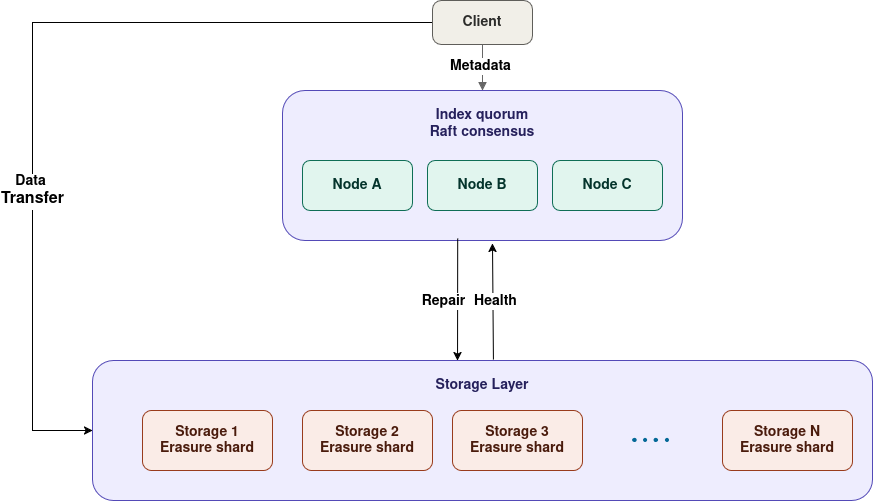
An Arkel deployment has three kinds of participants:
- Clients encrypt and erasure-code objects locally.
- Index nodes form a Raft cluster that owns the global metadata.
- Storage nodes hold encrypted shards that store data.
Participants
| Role | Command | Holds | Responsibilities |
|---|---|---|---|
| Client | arkel client | Master key, plaintext | Encrypt, erasure-code, build & sign manifests, fetch shards |
| Index node | arkel index | Raft log + SQLite state | Catalog, ownership, quotas, node registry |
| Storage node | arkel storage | Encrypted shard blobs | Register, store, serve, garbage-collect |
Write path
- The client picks storage targets from the healthy-node list and chooses an erasure configuration (
kdata +mparity shards; default 8 + 6). - The object is encrypted on the client with XChaCha20-Poly1305, using a per-object key derived via HKDF-SHA256 from the master key.
- The ciphertext is erasure-coded into
k + mshards. - The client hosts the shards locally and each storage node pulls its assigned shard over QUIC. Shards are content-addressed by BLAKE3.
- The client builds a manifest (object hash, sizes, shard placements), signs it, and commits it to the index cluster via Raft.
Because encryption happens before coding, every storage node only ever holds a slice of ciphertext.
Read path
- The client reads the manifest from the index cluster (owner-gated).
- It fetches the
kdata shards in parallel, substituting parity shards if any are missing, and reconstructs the ciphertext. - It decrypts once and verifies the plaintext against the manifest's BLAKE3 object hash. A corrupted or malicious shard fails the check.
Reads only need k of the k + m shards, so the object survives losing up to m nodes.
The index cluster
The metadata — buckets, objects, ownership, quotas, and the storage-node registry — is a replicated state machine built on OpenRaft. Every write (manifest commit, quota credit, node registration) is a log entry committed to a quorum of index nodes and applied deterministically to each node's SQLite state.
Reads are served under a leader lease and metadata is kept linearizable.
Storage nodes
Storage nodes hold shards as content-addressed blobs in an iroh-blobs store. They register their advertised address and capacity with the index, send heartbeats, and run a background Garbage collection loop to clean up dead references.
Background work
- Repair — a standalone, idempotent
arkel repairpass finds objects below their targetk/mand re-encodes and redistributes shards. - Garbage collection — storage nodes delete unreferenced shards on an interval; the index authorizes deletions scoped to the node's own placements.
- Contribution grants — the index periodically credits operators for the bytes they host, subject to an online grace period.